
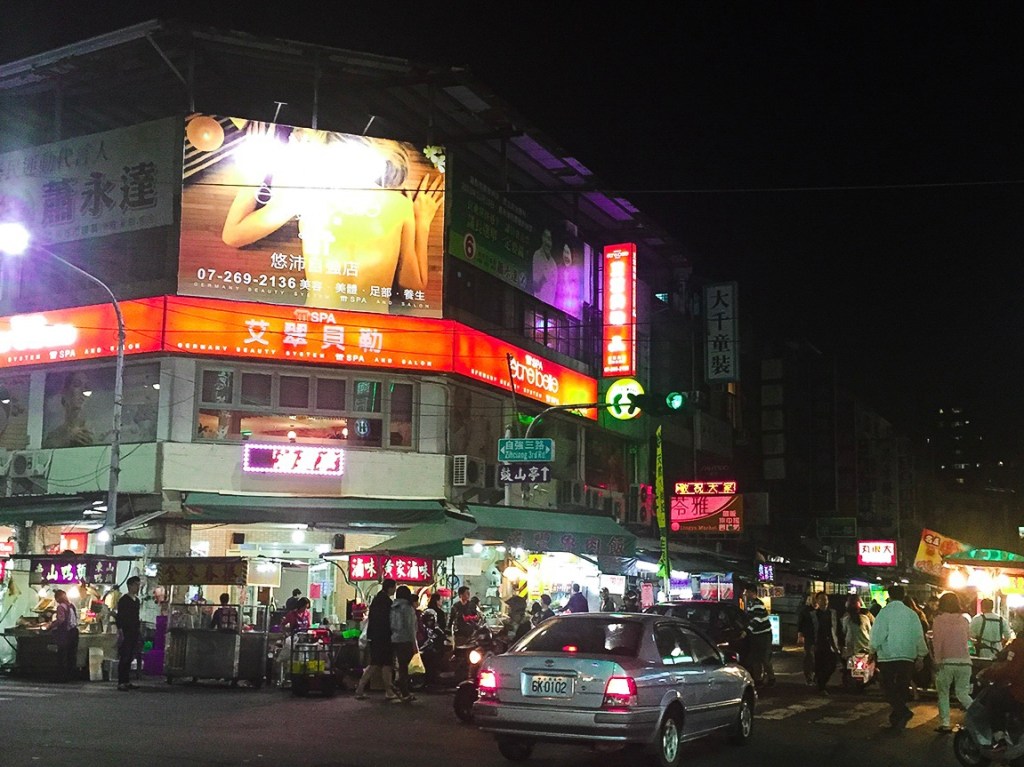
A Night Market in Kaohsiung, Taiwan, taken in 2015
Introduction
In 2019, the streets of Taipei erupted into a wave of rainbow flags and newlywed same-sex couples as 200,000 people attended the largest pride parade in Asia. Taiwan, a nation best known for its constant showdowns with mainland China, had just become the first country in the region to legalize gay marriage.[1] Often described as “the most progressive in Asia,” Taiwan’s support for gay rights stands out in a region filled with sexually conservative governments.[2] While many explain the island’s sexual openness as an inevitability of its democratic systems and Western geopolitical alignment, Taiwan was not always a beacon of progressivism. Just forty years ago, Taiwan was ruled by a Chinese nationalist dictatorship that instituted martial law and endlessly persecuted homosexuality. Taiwan’s journey towards its democratic and progressive policies today offers a curious look into the role of history and national identity on homosexuality.
In the past decade, scholars have attempted to explain Taiwan’s modern affinity for gay rights. The use of American-style music and artistry in the 1990s queer art movement led some to argue that the modern pride movement in Taiwan is mostly an offshoot of the scholarly trends on gender and sexuality studies in the United States and Europe.[3] Others argue that solely studying queer art and scholarship is elitist, and that local activists who merely adopted western trends turned a previously closeted community mainstream.[4] While these arguments are based on fact, it is essential to deeply examine the historical context of homosexuality far back in Taiwan’s history as that informs its modern social trends.
Though journalists and scholars often compare Taiwan to its East Asian neighbors, its history more closely resembles that of settler colonies such as the United States or Australia than the ancient civilizations of Korea, Japan, or China. Austronesian Aboriginals have lived on the island for millennia, however large-scale Chinese settlement and urbanization only began during the 1600s, under the Dutch and the Southern Ming Dynasty. In the following two centuries, Taiwan was a backwater of the Qing dynasty, and the multiple rebellions against Qing rule were quashed. [5] Then, Taiwan became a colony of Japan in 1895 after its seizure in the First Sino-Japanese War. Japan saw the island as an integral part of its empire, attempting to assimilate the Taiwanese people into Japanese culture. Japanese occupation ended in 1945, when the Republic of China (ROC) annexed the island, instituting Chinese-centric laws. The ROC’s retreat to the island after a communist takeover of the mainland began an era of martial law in Taiwan that lasted until 1987, when the island democratized.
This paper chronologically analyzes the role of homosexuality in Taiwan’s multicultural history, illuminating the parallels of the Taiwanese homosexual experience and Taiwanese national identity. In particular, it argues that Taiwanese history led queer acceptance to become an integral part of its modern national identity. While Taiwanese gay pride shares symbols with the American gay rights movement, the deeper roots of Taiwanese sexual tolerance lie in the clashing cultural influences of China and Japan. The modern origins of sexual deviancy in Taiwan can be traced back to the Japanese colonial era, during which Japanese assimilation led Taiwan to adopt Japanese customs of open sexuality and homosexuality. Meanwhile, the ROC under Generalissimo Chiang Kai-Shek’s Kuomintang (KMT) promoted a form of Chinese Nationalism based on strict adherence to a traditionalist neo-Confucian family structure. As the ROC retreated to Taiwan and adopted an identity as “Free China,” ideological purity and national security prompted a strict crackdown on homosexuality during Taiwan’s brutal martial law era. Consequently, the Taiwanese Independence Movement and Taiwanese Nationalism, as a blowback against the KMT’s oppression, became inherently queer movements. Gay rights aligned with Taiwanese Nationalism and its progressive libertarianism, a rejection of Chinese conservatism, and the dismantling of social hierarchies. As such, the Democratic Progressive Party, the political embodiment of Taiwanese Nationalism, thus became the driver of the Taiwanese Gay Rights Movement, and the movement’s success paved the way for Taiwan’s modern status as a bastion of LGBT rights in Asia. In essence, Taiwan’s embrace of queerness did not occur in isolation; it was the result of a century of Japanese and Chinese domination over the island, whose clashing cultures culminated in an independent Taiwanese nation with a national identity inclusive of gay rights.
Origins of Sexual Openness: Homosexuality in Japanese-Controlled Taiwan
During the Colonial Era (1895-1945), Taiwan aligned culturally and politically with its Japanese rulers, so its sexual policies and attitudes reflected those of Japan. Under the “Principle of Homeland Extension,” which aimed to turn Taiwan into an integral part of the Japanese Empire, Japanese authorities banned the Chinese language and encouraged the adoption of Japanese clothing, customs, and religion.[6] The Japanese assimilation campaign was so successful that by the end of Japanese rule in 1945, an estimated two-thirds of the Taiwanese population had been “Japanized.”[7] As such, Taiwan hosted a similar cultural and legal framework of sexual and romantic openness as Japan, hosting licensed Geisha houses and legal prostitution. Japan’s western-inspired crackdown on homosexuality had failed as the practice was deeply rooted in its culture. In particular, male homosexuality came to become associated with nationalism and masculinity due to the culture of Nanshoku among Samurai, involving anal sex between men. [8] In fact, the Japanese military saw numerous reports of homosexuality in its ranks. Young men who joined the military during World War Two often became described as “comfort women,” having sex with older officers.[9] While similar practices were common in other contemporary armies, Japan did not view homosexuality as a threat to its combat capabilities or national cohesion like the Americans, British, or Germans did. As such, Japanese authorities did not attempt to suppress homosexuality or male prostitution on Taiwan.
During the Taisho Period and early Showa Period (1912-1937), the normalization of free love and female sexuality led to homosexual attraction gaining prominence in popular discussion of romance in Japan. Homosexuality was openly discussed across the Japanese empire, including Taiwan. [10] Taiwan Women’s World, Taiwan’s largest colonial-era women’s magazine describes the ubiquity of lesbian romance in 1930s Taiwanese society, stating that “[Lesbianism] is a part of today’s society, existing among the women of the educated class, and even more among women of entertainment districts.” [11] Homosexuality being common among women with independent incomes, shows an increased recognition of it as an expression of female independence and free love. The same article also describes both male and female homosexuality as “deeper than heterosexual love,” showing a sense of homosexuality as form of raw love, away from the rigid marriage structures and family expectations that often denominated heterosexual marriage.[12] Although same-sex love remained on the fringes of normalcy, Taiwanese society during this time did not regard it as a sin or threat to society as in the West and China, but rather a deviant though natural expression of human sexuality.
KMT Suppression of Homosexuality and the New Life Movement
Japanese rule of Taiwan ended after its surrender to the Allied Powers in 1945. Immediately, an ROC task force landed on Taiwanese shores, with a mission to reestablish Chinese control over the island. However, during Taiwan’s five decades of separation from Chinese cultural development, the Chinese government under the KMT had become increasingly nationalistic and sexually conservative. The cultural clash between the arriving KMT and the Japanese-influenced Taiwanese natives lay the bedrock for modern Taiwanese politics and importantly for this discussion, homosexuality’s status as a symbol of Taiwanese independence.
China has a tradition of homosexuality since ancient times. However, in the early 20th century, Chinese society faced the subjugation of its culture by outside powers, and homosexuality became a scapegoat for the country’s national humiliation. Inspired by Western sexology and its proposed links between homosexuality and feminization, Chinese nationalists branded homosexual relations involving foreign citizens in China as attacks on Chinese masculinity and in turn, the nation. [13] Homosexuality’s subversion of the Confucian heterosexual family also became a matter of national security. In 1932, a Hangzhou man hosted a lesbian couple in his home when one of the women killed the other. Although the man was acquitted of complicity in the murder, his support of the lesbian couple and rumors of a relationship with one of the women’s brothers meant that he was still convicted. However, the crime was not a variation of sodomy or indecency as was common in the west, but “endangering the Republic of China,” a charge usually reserved for spies or communists.[14] By supporting relations outside of the Confucian family sphere, the man had threatened the social fabric and in turn, the nation.
Chinese conservatism’s opposition to sexual deviancy became part of the KMT’s nationalist agenda, embodied by generalissimo Chiang Kai-Shek’s New Life Movement. Often compared to the ongoing fascist movements of Italy and Germany, the movement aimed to solve the poverty, disunity, and national humiliation facing China by changing its people’s behavior, from hygiene practices to posture and tone of voice. In a 1934 speech announcing the movement, Chiang characterized it as “aiming to rationalize the lives of [the Chinese people], using the inherent values of China – propriety, righteousness, honesty and shame.”[15] Chiang employed both traditional neo-Confucian values and Christian morality as a basis for his vision of a nationalistic and militaristic China prepared to compete with Western imperialism and Japan. Therefore, his idea of righteous and proper behavior included filial piety and family structures. Chiang suggested “starting a family and enjoying family life” and “never going to prostitutes.”[16] While Chiang never directly mentions homosexuality, the promotion of a Confucian arranged marriage and sexual modesty, would necessarily characterize homosexuality as shameful. Traditionally, the concepts of filial piety and paternalistic family structures espoused by Confucianism include a duty to pass on the family bloodline by having children. Homosexuality outside of arranged marriages are antithetical to this vision, making it not only shameful, but a threat to the nation. Although the New Life Movement failed to gain support among the Chinese population, the belief that national greatness required changing the behavior of the Chinese peasantry provided the ideological foundations for the KMT’s policies on Taiwan.[17]
After Japan relinquished control over Taiwan in the aftermath of WW2, the ROC annexed the island, aiming to reincorporate it into China, both politically and culturally. Believing the Taiwanese to be infected with Japanese culture and values during its colonization, the KMT enacted a Sinicization policy which would reverse the Japanese assimilation campaign. The newly arriving police immediately instituted the Chinese language in schools and newspapers and replaced portraits of the Japanese emperor with ones of Chiang Kai-Shek. The mission of imprinting Chinese culture upon the Taiwanese people became more important to the KMT after the February 28th incident, an island-wide uprising in 1947.[18] While the deadly rebellion was mainly caused by hyperinflation, unemployment, and corruption, the KMT authorities blamed it on lingering Japanese influence and even communist infiltration on the island. [19] With thousands of protesters killed and martial law declared, the KMT consolidated control over Taiwan by censoring the press and constructing a police state.
In 1949, mainland China fell to the Chinese Communist Party (CCP), and Taiwan turned from a frontier region of the ROC to its last territory. The same conservative Chinese nationalists who advocated for a neo-Confucian state on the mainland were among the refugees fleeing to Taiwan. Seeing China taken by revolutionary communism, they called for the Taiwan rump state to put on the mantle of “free China,” (自由中國) hoping to eventually reclaim the mainland. The goal of assimilating the Taiwanese natives and instilling in them KMT ideology and a yearning to retake mainland China became ever more important as the KMT consolidated its position over Taiwan. At the same time, they also distrusted the native Taiwanese and used the February 28th incident as an excuse to deprive them of political power and censor the press.[20] During the decades-long period of martial law, no elections were held, and mainland legislators elected in 1947 continued holding power in Taiwan until democratization in the 1980s. In the oligarchic system of mainlander rule, just 10% of the legislators represented the native Taiwanese despite them being 85% of the ROC’s population.[21] Because of this, the ideology of early 20th century Chinese nationalists remained official government policy even as the Taiwanese people moved away from traditionalism.
The KMT’s vision of “Free China” preserved traditional Chinese values, and Chiang’s government enforced the Confucian family structure, continuing the New Life Movement. With the Cultural Revolution on the mainland was destroying traditional institutions and historical monuments, the ROC embraced tradition and history to justify its continued existence and authoritarian rule. In 1966, Chiang criticized the communist party as a “cult of inhumane and unforgivable sins,” contrasting it with “Confucius’ ethical and political philosophy” and “the behavior of filial piety, respecting the elderly, and nurturing the young” guiding the ROC.[22] Adopting New Life Movement doctrines, the ROC attempted to militarize Taiwanese society by enforcing the Confucian family. While the Confucian family was ostensibly a product of KMT ideology and Chinese conservative nationalism, it also served as a vehicle to exert state-control, using patriarchal power dynamics to regulate rebelliousness in the youth. A 1958 document promoting the New Life Movement even blames the February 28th incident on a “lack of morality among the Taiwanese people,” showing that the KMT viewed promoting traditional values as a matter of national security.[23] As such, the police were to aggressively enforce the Confucian social order. The 1953 police law, a document that governed Taiwan during the martial law period, stipulated that the police had a duty to enforce “correct customs,” while also granting the ability to issue punishments without judicial process.[24] With extrajudicial power and a prerogative to correct the morality of their citizens, the police could regulate almost every facet of life, including the sexual.
Prostitution was a primary target of Sinicization due to its association with Japanese rule and clear violation of New Life Movement doctrines. As early as 1946, the KMT had already begun forcibly closing brothels, believing that “our Taiwanese countrymen were allowed under Japanese occupation to wallow in immorality.”[25] Businesses such as cafes and tea houses were also subjected to strict regulation as they were often sexual spaces during Japanese occupation. ROC criminal law prohibited “committing or encouraging an obscene act…with the intent to make a profit,” which targets both male and female prostitutes as extramarital sex was considered an “obscene act.” Despite being illegal, however, prostitution remained common in Taiwan’s growing urban centers, often in inconspicuously labeled businesses. The emergence of “restaurants without kitchens,” a term describing brothels with restaurant storefronts, led to strict regulation on sexual life and business. From the clothing of wait staff to the wattage of light bulbs, government regulations aimed to combat sexuality in public spaces.[26] Police even enterred hotel rooms for unscheduled checks to suppress the sex trade, questioning young couples for signs of prostitution or adultery. [27] An environment with such heavy controls on sexuality made the institutional persecution of homosexuality almost inevitable, considering that the ROC already considered homosexuality a threat to the nation.
Although anti-prostitution laws never mention homosexuality outright, the law against prostitution became, in practice, a ban on all male homosexuality. As Hans Tao-Ming Huang explains in a 2004 paper, “[the police] made little or even no distinction between so-called male prostitutes and homosexuals.”[28] While a 1981 police report on the homosexual community in Taipei uses the terms for homosexuals and male prostitutes interchangeably, its section on the homosexual sex market states that the majority of homosexuals “can be men but are also willing to act as ‘women.’ The one who is invited get paid.”[29] As most homosexuals aren’t necessarily charging money, the system described does not seem like prostitution as the report suggests, but a market for gay cruising. These men mainly desire sexual pleasure, not money. There is also reasonable doubt that the versatile homosexuals previously described actually exchanged money.[30] A 1983 article in a Central Police College publication titled “How to Outlaw Homosexuals,” suggests “pretending like you are actually going to do it” and “asking the other party if they are experienced,” but never discusses pricing or exchanging money.[31] Although there was were actual male prostitution businesses in Taipei, police descriptions of “male prostitutes” suggest that many arrested for prostitution were not, in fact, prostitutes, but ordinary homosexual men looking for sex. Part of the police’s overgeneralizations may stem from a belief that no male would play a receiving role without monetary compensation, however, the primary reason is likely that equating homosexuality with prostitution provides a justification to crack down. Because the 1953 police law gave the police extrajudicial power to enforce vague morality laws, the already conservative police could use directives against prostitution to target homosexuality. Considering that police wrote a previously mentioned manual on “How to Outlaw Homosexuals,” recommending tips to arrest homosexuals while following the law, it is clear that the police exercised their power to enforce their interpretations of the criminal codes.[32]
The few depictions of homosexuality during the martial law era usually refer to it in the context of tragedy, murder, and mystery, reflecting the KMT’s belief in homosexuality as a source of social breakdown. For example, a 1975 article describes how an 18-year-old girl “committed suicide by having a large amount of methamphetamine,” after “her girlfriend had another boyfriend, which alienated her.”[33] Homosexual suicide is almost always attributed cheating and break-ups rather than social stigma, depicting homosexuality as a love of passion that destroys lives. Additionally, the homosexual community in Taipei New Park became described as gangs of juvenile delinquents. A 1967 news article graphically describes a gang fight between likely gay high schoolers in the park where “blood flowed out of a boy until he died.”[34] By associating homosexuality and free love with societal problems such youth suicide, drug abuse, and gang violence, newspapers tacitly encourage arranged heterosexual marriages as a social antidote. At the same time, many newspapers in the 1970s reflect a sense of fascination or perhaps morbid curiosity about homosexuality. During this time, the term 人妖, which directly translates to either “bizarre human” or “human devil,” became common for describing those defying heteronormativity or gender norms. A news article from 1974 describes how a “人妖” was “discovered… in a homosexual love triangle,” with the headline “Uncovering the Mystery of Homosexuality.”[35] By othering the person as being inhuman and exoticizing them, the article turns homosexuality into entertainment based on disgust and fear. With a newer generation less enraptured by the KMT’s ideological goals, homosexuality in 1970s Taiwan symbolized the fear of societal breakdown in the youth.
The Taiwanese Independence Movement and the Queer Nation
Although the KMT maintained an appearance of unity in Taiwan, resentment boiled beneath the surface among the native Taiwanese and the descendants of KMT refugees. The KMT’s Chinese nationalism seemed hollow and out-of-touch as the government continued to devote resources to the unattainable goal of retaking the Chinese mainland. Those born in Taiwan felt little connection to a Chinese nation that had not existed for twenty years, and even began to feel nostalgic for Japanese occupation. As exemplified by the common Taiwanese saying, “dogs go, pigs come,” the Chinese administration was seen as no better than the Japanese one, being another parasitic colonial government imposed on Taiwan. Members of the Taiwanese diaspora called on the American government to hold the KMT accountable for its authoritarianism, questioning the branding of “free China.”[36] After the ROC was expelled from the United Nations in 1972 and the US recognized the People’s Republic of China (PRC), the myth of the ROC representing a “free China” collapsed. The KMT could no longer claim to represent the real China, and the existing undercurrents of anti-government resentment coalesced into the Taiwanese Independence Movement.[37] While the Taiwanese Independence Movement is commonly referenced in the context of cross-strait relations today, it originated as a movement against the KMT, calling for the government to accept the status quo and focus on local issues rather than Chinese nationalism. After Chiang Kai-Shek’s death, pressure on the government to hold new elections led to the end of martial law in 1987 and the legalization of the Democratic Progressive Party (DPP), which advocated for a Taiwanese nation independent of Chinese influence.
During the 80s, the DPP and Taiwanese independence supporters developed a national myth centered around a progressive, libertarian identity. Similar to other Creole Nationalist movements, the Taiwanese Independence Movement emphasized nationhood based not on ethnicity, but rather on libertarian ways of thinking and cultural influences from external powers, specifically the United States and Japan.[38] In 1982, four imprisoned Taiwanese politicians made a statement that echoes the American pilgrims myth:
Our brave ancestors settle in Taiwan, in order to gain freedom. With their new thinking and new way of life, they developed a spirit of self-reliance and laid the foundation for a democratic society.[39]
Due to China’s historical domination by centralized, autocratic regimes, these politicians created a national fiction of settlers escaping such governments in order to construct a new libertarian society. However, the statement’s mention of new ways of thinking and a “spirit of self-reliance” also implies a desire for liberation from the overbearing, collectivist Confucian society. As a result, the statement not only reflects resistance against the authoritarianism of the KMT, but also against Chinese Confucian teachings. In this way, the Taiwanese Independence Movement embraced a creole Taiwanese Nationalism, perceiving Taiwan as not only independent, but also more progressive and individualistic than China.
One of the most poignant depictions of the male homosexual experience in Taiwan was the 1983 novel Crystal Boys by Pai Hsien-Yung, which humanizes homosexuals and male prostitutes in the context of the shifting cultural ethos in 1970s Taiwan. The book follows A-Qing, a homosexual teenager who gets thrown out of his house after being caught having “scandalous relations” with a male classmate. After wandering the streets of Taipei, he ends up in Taipei New Park, where he joins a community of boys in similar situations, often relying on prostitution to survive.[40] However, Crystal Boys is not an ordinary coming out story. Pai, a second-generation refugee to Taiwan, had previously written “Taipei People,” on the insecurities of mainland refugees who are still spiritually on the mainland.[41] As such, Crystal Boys was Pai’s continuation of that theme, using homosexuality to discuss the second generation’s embrace of Taiwan. The dynamic of father and gay son was a metaphor for Taiwan’s orphan nation status as it formed a national identity away from China. A-Qing’s father, a war hero during the Second Sino-Japanese war, still lives in the past, his actions during an undisclossed Battle of Changsha remaining his only source of pride while he lives divorced and unemployable on Taiwan. As A-Qing’s father attempts to imprint in his son military discipline and reverence for Chinese history, A-Qing “felt like laughing, but he forced himself to hold back, seeing the solemnity on [his father’s] face.”[42] Similar to A-Qing’s father, the KMT in the 1970s clinged onto a nonexistent Chinese nation as it became increasingly out-of-date and useless to the newer generation. Like the KMT’s failure to fully assimilate the Taiwanese people, A-Qing’s father’s vein attempts to enforce sexual norms upon his family only alienates them further, as his native Taiwanese wife leaves him, and his son ends up estranged and becomes a male prostitute.[43] However, being kicked out of his father’s house leads A-Qing to self-reliance and brotherhood in the homosexual community, eventually allowing him to escape prostitution and become an independent man, free to work, live, and love as he pleases.[44] Pai’s choice of using homosexuality to represent Taiwan’s increasingly independence-minded society is telling. Crystal Boys tells its readers that by abandoning the old and embracing a new identity unafraid to violate rigid tradition, Taiwan’s new generation could liberate itself. In this way, tolerance for sexual expression represented a new independent and democratic chapter for Taiwan.
As a rapidly democratizing Taiwan imported the American gay rights movement, scholars applied the queer framework of solidarity and escape from victimization and binaries to Taiwan’s political environment. In what can only be described as a Taiwanese queer awakening, Taiwanese nationalism became tied to queerness in academic circles. As described by American queer philosphers, queerness represents a rebellion against the sexual and gender status quo, which is not necessarily natural, but an artificial social construct. Additionally, the modern expections of family structures and gender roles are tied to the societal mechanisms and state institutions that enforce them. This means that queerness and queer rights represent a general emancipation from classist and ethnic inequalities. [45] The Taiwanese gay rights movement typifies this notion of gay rights being one piece of societal liberation through its connection to Taiwanese Nationalism. As Ka Weipo points out in his 1998 paper “What is queer?”
The marginal position of the queers and their alternative gestures of resistance are familiar to Taiwan’s non-ethnic nationalism … The seemingly self-scandalizing terms of ‘democracy for scum’ and ‘fake Taiwanese’ (a queerification of the Taiwanese) …are the precursors for the local appearance of queerness today.[46]
In essence, pro-independence Taiwanese could empathize with the plight of queer people and their yearning for freedom from rigid social structures. Facing the same enemy in the KMT, Taiwan’s most influential gay rights activist, Chi Chia-Wei, even stayed in the same prison cell as Taiwan’s future DPP president, Chen Shui-Bian.[47] Ka’s references to terms used against Taiwanese nationalists as a “queerification of the Taiwanese,” points out the inherent parallels between the Taiwanese queer experience and Taiwanese Nationalism.
Even the translation of “queer” into Chinese reflects the general societal changes inspiring queer Taiwan. Rather than expressing the reclamation of a derogatory term, Taiwanese gay rights activists in the early 1990s chose “酷兒” (ku’er), a phonetic translation that means “cool child.” [48] Translating the term as “Cool child” put gay rights in the center of Taiwanese identity politics, connecting queerness to a new generation which embraces their Taiwanese status and the future. At the same time, the image of defiance and embrace of sin became increasingly common in queer circles, as words such as 邪(xie) meaning wicked, became a substitute for the adjective use of “queer.”[49] Esentially, while queer people themselves were described as having a child-like happiness, the cultural movement they represented was rebelliously sinful and proudly so. In other words, queers represented the Taiwanese youth and their thirst for change.
As homosexuality became a symbol of rebellion against historical oppression, gay rights and sexual liberation turned into key components of the Taiwanese nationalist counterculture, as shown by the 臺客(Taike) aesthetic. Taike was a genre of music and aesthetic describing a new generation of Taiwan-centric musicians and artists. Like “queer” for LGBTQ+ activists in the English-speaking world, Taiwanese nationalists reclaimed Taike, a formerly derogatory term used against native Taiwanese for their supposedly crude and uncivilized behavior.[50] By reappropriating the term as an artistic subculture based on the violation of societal and sexual norms, Taiwanese nationalists employed a term of classism and oppression as one expressing unabashed pride in one’s Taiwanese identity. Xie Jin-Yan, a Taiwanese pop star described as a “gay man culturally” for her alternative depictions of gender norms, embodies the Taike queer aesthetic.[51] In a 2014 speech, she described Taike as “fashionable, sexy, and mainstream” while expressing pride in her Taiwanese identity: “We are the owners of this land, so we want to say that we are…proud to live in Taiwan.”[52] Because her music and aesthetic was the antithesis to the KMT’s Chinese Nationalist agenda, pride in her Taiwanese identity represents a own-the-haters mentality, embracing the vulgarity of Taike. Although she was not a gay rights activist herself, a Taiwanese Pop Culture Academy article describes her popularity with queer men as a symbol of how “different cultures connect and blend… developing Taiwanese cultural possibilities.”[53] Xie’s status as a women playing a masculine role in her music embodies the queer experience of questioning societal roles, whether that be homosexuals violating the Confucian family or the Taiwanese’ apathy toward the KMT’s yearning for mainland China. Taike thus represents a unified pride among the diverse and sometimes queer people of Taiwan for living on the tiny tropical island the KMT wanted to leave.
To many progressive thinkers, Taiwan was to be a nation not united by ethnicity but a common experience of political and cultural oppression including everyone, from women to Taike to homosexuals. A 1995 editorial in Island Margin’s “Pornographic Nation,” illustrates this idea:
The question of nation is closely related to the coming out of the ku’ers…Our nation ought to be a Queer Nation—a women’s, ku’ers’, workers’, aborigines’, and disabled’s nation. Without us queers, there won’t be any community with a shared destiny. This nation is ours, the queers’.[54]
The editorial basically argues that the emerging Taiwanese nation should aim to queer. It should include all facets Taiwanese society and attempt to eliminate social inequalities, including heteronormativity. As scholars reexamined Crystal Boys during the 1990s, they explored the notion of A-Qing not being an estranged son, but a citizen of an underground queer Taiwanese nation made of those disenfranchised by the ROC.[55] Pai describes the gay community in Taipei New Park as a “kingdom” with “no distinctions of social rank, eminence, age, or strength.”[56] To many queer activists and Taiwanese nationalists, Crystal Boys and queer theory showed what an egalitarian independent Taiwan could be like. In other words, Taiwanese Independence should be the coming out of a hidden queer nation which hid in the dark corners and the less-than-glamorous native class of Taiwan. Thus, a queer national myth for Taiwan was born: the queer island of democracy, progress, and equality.
As such, Taiwan hosts a curious political dynamic different from most nations; the more nationalistic party, the DPP, is more progressive. After the DPP defeated the KMT in the 2000 election, newly elected president Chen Shui-Bian enacted a de-Sinicization campaign, also known as the Taiwanization movement. The political embodiment of Taiwanese Nationalism, Taiwanization emphasized local Taiwanese culture, introducing a new history textbook centered around Taiwan rather than China and changing the Taiwanese passport from being labeled “Republic of China” to “Taiwan.” [57] It was not a coincidence that the same administration also enacted the Gender Equity Education Act of 2004, which included some of the most progressive anti-discrimination laws for queer students in Asia.[58] Chen’s 2004 inauguration speech focused on building a “Taiwan where social justice [and] gender justice…are realized,” illustrating the connection between his vision of an independent Taiwan with social liberalism. [59] Since then, the DPP has been the engine for gay rights in Taiwan. They submitted marriage equality bills in 2003 and 2016, and appointed Hsu Tzong-Li, the justice who led the Judicial Yuan to legalize gay marriage in 2017. The party has also rhetorically supported LGBT rights, as can be seen by the numerous DPP polticians who have attended pride parades.[60]
The DPP’s success has shifted Taiwanese views towards homosexuality. Although Taiwan has a relatively developed and vibrant queer scene, Taiwanese society until recently was actually starkly divided on issues such as gay marriage, anti-discrimination laws, and LGBT education. In fact, a majority of Taiwanese voters voted against the legalization of gay marriage in a 2018 referendum, though the DPP-controlled legislature overturned it. The gay rights movement has instead been able to use its association with Taiwanese Nationalism to advance its goals. Post martial law, Taiwanese independence turned from a fringe movement to a majority opinion, especially among the younger generation. Just 18% of Taiwanese self-identified as “solely Taiwanese” in 1992, but that figure has tripled to 67% in 2020.[61] Whether caused by the Taiwanization policy, cross-strait tensions, or the aging of an older generation, the changes in Taiwanese identity have shifted the political outlook for gay rights. In 2016, Tsai Ing-wen one of the most pro-independence Taiwanese leader more than decades came into office with a promise of marriage equality. As the DPP-controlled Legislative Yuan voted on gay marriage in 2019, Tsai sent a tweet, calling for Taiwan to “show the world progressive values can take root in an East Asian society.”[62] For many Taiwanese, the vote was not just a vote on gay marriage, but whether the nation of Taiwan would embrace its multicultural queer identity, where progressivism combines with traditionalist East Asia. The view of gay rights showing Taiwan’s status in the world became convincing to many, especially as the PRC under Xi Jinping suppressed LGBT voices.[63] As its conservatism and connection to the past becomes an electoral liability, even the modern KMT has also used gay rights to distance itself from the Chiang Kai-Shek regime. After a stinging defeat in the 2020 election, the KMT leadership pivoted the party leftward by forgoing a visit to Chiang’s mausoleum and instead attending a pride parade.[64] A firm illustration of rising progressivism in Taiwan’s increasingly independence-minded society, the move cements the island’s identity as a proud bastion of gay rights in Asia.
Conclusion
Taiwan’s 2019 legalization of gay marriage put the nation’s gay rights movement in the global spotlight, however, the history of homosexuality on the island run deep. This paper examined homosexuality’s development on Taiwan, from its relaive openness during Japanese rule to a brutal crackdown under the ROC to Gay Marriage in the modern Taiwanese nation. Each stage of Taiwanese history interacts with the next in a cultural and intellectual way, and homosexuality provides a thread through time of Taiwanese society. Chinese Nationalism, partially based on rigid conformity to the Confucian family, clashed with Japanese open sexuality, leading to a strict suppression of homosexuality on Taiwan through the lens of prostitution. As the Taiwanese independence movement formed, Taiwan’s national identity has become intertwined with libertarian progressivism. As many contemporary scholars recognized, Taiwanese Nationalism was also a queer movement based on a counterculture and rebellion against Confucian norms and the Chiang regime’s authoritiarianism. Thus, the gay rights movement in Taiwan was not on its own; it fought for greater rights with a diverse set of Taiwanese nationalists aiming to liberate an underground Taiwanese nation. This underground nation was a queer one, including not only homosexuality but sexual liberation and democratic values. As the gay rights movement gains ground in nations with diverse cultures and values, Taiwan shows a unique path forward where gay rights joins ongoing cultural trends and nationalism. Taiwan illuminated its queer nation, and it provides hope for queer people in Asia that one day, their queer nation will emerge too.
Endnotes
[1] Any reference to the status of Taiwan is going to be inherently politically controversial. However, because this essay is examining Taiwanese history through a nationalistic and queer lens, I will refer to Taiwan as a “nation” and a “country.”
[2] Cecila Miller, “LGBT Rights in Taiwan: What Travellers Should Know Before Going,” Queer in the World, last modified December 3, 2023, accessed July 21, 2024, https://queerintheworld.com/lgbt-rights-in-taiwan/.
[3] See: Chen, Ya-chen, “Queering Women in Taiwan,” American Journal of Chinese Studies 23, no. 2 (2016): 239–56, http://www.jstor.org/stable/44289157; Yue, Audrey, “Queer Asian Cinema and Media Studies: From Hybridity to Critical Regionality,” Cinema Journal 53, no. 2 (2014): 145–51, http://www.jstor.org/stable/43653576.
[4] “Coming out of History and Coming Home: Homosexual Identification in Pai Hsien-Yung’s: ‘Crystal Boys,’” Chinese Literature: Essays, Articles, Reviews (CLEAR) 39 (2017): 135–52, http://www.jstor.org/stable/45014214.
[5] Peter Bellwood, “Austronesian Prehistory in Southeast Asia: Homeland, Expansion and Transformation,” In The Austronesians: Historical and Comparative Perspectives, edited by Peter Bellwood, James J. Fox, and Darrell Tryon, 110. ANU Press, 2006. http://www.jstor.org/stable/j.ctt2jbjx1.8.
[6] He, Yinan, “Identity Politics and Foreign Policy: Taiwan’s Relations with China and Japan, 1895-2012.” Political Science Quarterly 129, no. 3 (2014): 471. http://www.jstor.org/stable/43828438.
[7] Huang Ying-che, “Were Taiwanese Being ‘Enslaved’? The Entanglement of Sinicization, Japanization, and
Westernization,” in Liao Ping-hui and David Der-wei Wang, eds., Taiwan Under Japanese Colonial Rule,
1895-1945: History, Culture , Memory (New York: Columbia University Press, 2006), 312.
[8] Mark J. McLelland, “Japan’s Queer Cultures,” University of Wollongong Press, 2011, 5.
[9] Mark J. McLelland, “Japan’s Queer Cultures.” University of Wollongong Press, 2011, 5.
[10] Chen, Pei-jean, “Colonial Modernity and the Empire of Love: The representation of Same-Sex love in Colonial Taiwan and Korea,” Journal of Taiwan Literary Studies, 2013, 109.
[11] “Strange Same-Sex Love,” [奇しき同性の愛], Taipei Women’s World, Issue 6165, August 26, 1917, 7.
[12] Ibid.
[13] Kang Wen-qing, Obsession: Male Same-Sex Relations in China, 1900-1950 40.
[14] “Tongxinlianai yinnu liesha zuojia Xuranwen wuqi juanrumingan同性恋爱因妒残杀作家许钦文无辜卷入命案” [Gay Love Jealousy Murders Writer Hsu Chin, Innocent Man Involved in Murder Case], Xiandai Waibao 现代快报, Last modified August 22, 2011, https://news.sina.com.cn/c/2011-08-22/042623028186.shtml?from=wap. (accessed July 20, 2024)
[15] Chiang Kai-Shek 蔣介石, “Xinshenghuoyundong zhiyaoyi 新生活運動之要義,” [The essence of the New Life Movement], Transcript of Speech Delivered in Nanchang, February 19, 1934, https://zh.wikisource.org/wiki/新生活運動之要義.
[16] Chiang Kai-Shek 蔣介石, “Xinshenghuoyundong gangyao 新生活運動綱要,” [Outline of the New Life movement], Transcript of Speech Delivered in Nanchang, May 15, 1934, http://www.ccfd.org.tw/ccef001/index.php?option=com_content&view=article&id=351:0001-67&catid=210&Itemid=256.
[17] Dirlik, Arif. “The Ideological Foundations of the New Life Movement: A Study in Counterrevolution.” The Journal of Asian Studies 34, no. 4 (1975): 945–80. https://doi.org/10.2307/2054509.
[18] Shih, Cheng-feng, and Mumin Chen. “Taiwanese Identity and the Memories of 2-28.” Asian Perspective 34, no. 4 (2010): 85. http://www.jstor.org/stable/42704735, 98.
[19] Makinen, Gail E., and G. Thomas Woodward. “The Taiwanese Hyperinflation and Stabilization of 1945-1952.” Journal of Money, Credit and Banking. 1989. 91.
[20] Shih Cheng-feng, and Mumin Chen, “Taiwanese Identity and the Memories of 2-28,” 99
[21] Ibid., 101
[22] Chiang Kai-Shek 蔣介石, “Zhōnghuá mínguó wǔshíwǔ nián guóqìng jìniàn gào quánguó jūnmín tóngbāo shū 中華民國五十五年國慶紀念告全國軍民同胞書” [Message to Fellow Soldiers and Civilians Across the Country on the Occasion of the 55th National Day of the Republic of China], Transcript of speech delivered in Taipei, October 10 1966, https://zh.wikisource.org/wiki中華民國五十五年國慶紀念告全國軍民同胞書.
[23] Chen Junhong 陳俊宏, “Chénjùnhóng tí’àn jiànyì zhèngfǔ huànqǐ guórén yīzhì fèng háng zǒngtǒng hàozhào xīn shēnghuó yùndòng 陳俊宏提案建議政府喚起國人一致奉行總統號召新生活運動” [Chen Junhong’s proposal suggests that the government arouse the people to unanimously follow the president’s call for a new life movement], Official Document, 1958, 3.
[24] “Jingchafa 警察法” [Police Law], Republic of China, 1953.
[25] Hongxun Lin 林弘動, “Táiběi shì fèi chāng yǔ táiwān chāngjì shǐ 台北市廢娼與台灣娼妓史” [Taipei city’s abolition of licensed prostitution and the history of prostitution in Taiwan], Contemporary Journal 當代 122: 111, 1997.
[26] “Qǐng sù Tourishimari yín wō toukū請速取締淫窩賭窟”[Please act fast to outlaw sleazy grottos and gambling dens’], China Times, 15 June, 1971.
[27] Hans Tao-Ming Huang, “State power, prostitution and sexual order in Taiwan: towards a genealogical critique of ‘Virtuous Custom,’” Inter-Asia Cultural Studies, 5, no. 2, (2004): 246.
[28] Ibid., 248.
[29] Lin, Jiongren林炯仁 “Nào tóngxìngliàn zhě de bēigē鬧同性戀者的悲歌”[The elegy of homosexuals], Taiwan Daily, September 12, 1981.
[30] Although the term “versatile” is not used in Taiwan, I have chosen to use it to refer to men who are willing to be both the receiving and penetrating partner for brevity and clarity to an English-speaking audience.
[31] Li, Jinzhen 李錦珍, “Rúhé qǔdì tóngxìngliàn-nánchāng 如何取締同性戀-男娼” [How to outlaw homosexuals-male prostitutes], 45th Anniversary of the Central Police College Special Publication, 1981, 96.
[32] Ibid.
[33] “Liǎng qíng huān qià tóngxìngliàn, yī jiāo nányǒu yī shī huān, línyùxiù zìjìn xiāng xiāo yù yǔn 兩情歡洽同性戀,一交男友一失歡,林玉秀自盡香消玉殞” [They were in love with each other and were gay. Once they got a boyfriend and then fell out of love, Lin Yuxiu committed suicide and passed away], Taiwan People’s Daily臺灣民聲日報, July 30, 1975.
[34] “Dài yǎnjìng shòu qīwǔ, zǔ bānghuì bá dāozi 戴眼鏡受欺侮,組幫會拔刀子“ [Wearing glasses and being bullied, gang members will draw knives], Taiwan People’s Daily 臺灣民聲日報, November 27 1967.
[35] “Zhōng shì yǒu gè yīnyáng rén, tóngxìngliàn jiē kāi dǐ shì 中市有個陰陽人,同性戀揭開底事” [Central City has a Yingyang Person, Uncovering the Mystery of Homosexuality] Taiwan Minsheng Daily 臺灣民聲日報社, February 27, 1974.
[36] Chai, Trong R, “The Future of Taiwan,” Asian Survey 26, no. 12 (1986): 1320,
https://doi.org/10.2307/2644549.
[37] J. C. Copper, “Taiwan,” Encyclopedia Britannica, July 28, 2024, https://www.britannica.com/place/Taiwan.
[38] He Yinan, “Identity Politics and Foreign Policy: Taiwan’s Relations with China and Japan, 1895-2012,” Political Science Quarterly 129, no. 3 (2014): 469–500, http://www.jstor.org/stable/43828438.
[39] Ibid., 1319.
[40] Pai Hsien-Yung 白先勇, Nie zi 孽子 [Crystal Boys], 1983, Gay Sunshine Press.
[41] Xiāo yì 蕭軼, “Báixiānyǒng: Wǒmen quē yī běn kèguān, yǒu guāndiǎn de kàngzhàn shǐ 白先勇:我們缺一本客觀、有觀點的抗戰史” [Pai Hsien-yung: We lack an objective and opinionated history of the War of Resistance], New York Times, July 28 2015, https://cn.nytimes.com/culture/20150728/tc28baixianyong/zh-hant/, Accessed June 17 2024.
[42] Pai Hsien-Yung 白先勇, Nie zi 孽子 [Crystal Boys], 49.
[43] Ibid., 38.
[44] Ibid., 187.
[45] For more on the idea of a “queer nation” and queer theory as applied to the Western World, I would recommend the following works: Lauren Berlant and Elizabeth Freeman, “Queer Nationality,” Boundary 2 19, no. 1 (1992): 149–80, https://doi.org/10.2307/303454; Lima, Álvaro Luís. “Screw the Nation!: Queer Nationalism and Representations of Power in Contemporary South African Art,” African Arts 45, no. 4 (2012): 46–57, http://www.jstor.org/stable/41721404; Rudy, Kathy, “Radical Feminism, Lesbian Separatism, and Queer Theory,” Feminist Studies 27, no. 1 (2001): 191–222, https://doi.org/10.2307/3178457.
[46] Ka Weipo 卡維波, “Shenmeshi Ku’er 什麼是酷兒” [What is ku’er (queer)?], Queer and Sex Studies, 1998, PDF, https://sex.ncu.edu.tw/members/Ning/publication/academic/papers/what-is-queer.pdf, Accessed July 1, 2024, 40.
[47] “I Was Immediately Arrested And Held For More Than Six Month” Radio Free Asia, May 24 2019, https://www.rfa.org/english/news/china/arrested-05242019111638.html, Accessed April 21 2024.
[48] Ka Weipo 卡維波, “Shenmeshi Ku’er 什麼是酷兒” [What is ku’er (queer)?], 2.
[49] “Guó zú zhǔyì yǔ qù zhímín國族主義予去殖民” [Nationalism and decolonization], 島嶼邊緣 Island Margin 14 (Sept 1995): 29.
[50] Nathanal Amar, “Review of Sonic Plurality in Multicultural Taiwan.” China Perspectives, no. 130 (2022): 77–80. https://www.jstor.org/stable/27173146, Accessed June 5, 2024.
[51] Lian Yanfu賴彥甫, “Tái zǐ làngcháo: Xièjīnyàn de tái kè wényì fùxīng yǔ nán tóngzhì wǔqǔ wénhuà台姊浪潮:謝金燕的台客文藝復興與男同志舞曲文化,”[The Wave of Taiwanese Sisters: Xie Jinyan’s Taiwanese Renaissance and Gay Dance Music Culture] Pop Culture Academy, December 14, 2015, https://popcultureacademytw.com/2015/12/14/thewaveoftaiwansister/, Accessed June 5, 2024.
[52] Ibid.
[53] Ibid.
[54] “Guó zú zhǔyì yǔ qù zhímín國族主義予去殖民” [Nationalism and decolonization], 島嶼邊緣 Island Margin, 29.
[55] Chen Li-fen, “Queering Taiwan: In Search of Nationalism’s Other,” Modern China 37, no. 4 (2011): 390, http://www.jstor.org/stable/23053329.
[56] Pai Hsien-Yung 白先勇, Nie zi 孽子 [Crystal Boys], 1.
[57] Stockton, Hans. “National Identity on Taiwan: Causes and Consequences for Political
Reunification.” American Journal of Chinese Studies 9, no. 2 (2002): 155–78.
[58] Daniel Lynch “Taiwan’s Democratization and the Rise of Taiwanese Nationalism as Socialization to Global Culture,” Pacific Affairs 75, no. 4 (2002): 558, https://doi.org/10.2307/4127346.
[59] Chen Shui-Bian, “Paving the Way For A Sustainable Taiwan: Presidential Inauguration Address,” transcript of speech delivered in Taipei, Translated by USC, May 20, 2004, https://china.usc.edu/chen-shui-bian-%E2%80%9Cpaving-way-sustainable-taiwan-presidential-inauguration-address%E2%80%9D-may-20-2004
[60] Daniel Lynch, “Taiwan’s Democratization and the Rise of Taiwanese Nationalism as Socialization to Global Culture,” 560.
[61] Wo Pu-hsuan and William Hetherington, “Record Number identify as ‘Taiwanese,’ poll finds,” Taipei Times, July 5 2020. https://www.taipeitimes.com/News/front/archives/2020/07/05/2003739375.
[62] Tsai Yin-Wen, “On May 17th, 2019 in #Taiwan, #LoveWon. We took a big step towards true equality, and made Taiwan a better country.” May 17, 2019, https://x.com/iingwen/status/1129272671873617920?ref_src=twsrc%5Etfw, Accessed July 30 2024.
[63] Thompson Chau, “For many, being Taiwanese means being pro-LGBTQ+,” Nikkei Asia, November 14, 2022, https://asia.nikkei.com/Life-Arts/Life/For-many-being-Taiwanese-means-being-pro-LGBTQ.
[64] “Bù jì jiǎngjièshí què qù cānjiā tóngxìngliàn yóuxíng, guómíndǎng shì zài zhuīqiú `jìnbù jiàzhí’? 不祭蔣介石卻去參加同性戀遊行,國民黨是在追求「進步價值」” [By not commemorating Chiang Kai-shek but attending a gay parade, is the Kuomintang pursuing “progressive values”?], Kknews, October 31, 2020, https://kknews.cc/zh-tw/n/m9r4ez2.html.
Bibliography
Primary Sources
“Always and everywhere, strengthen our resistance.” 1937, Poster, Landsberger Collection.
https://chineseposters.net/posters/d25-200
British Pathé. “Taiwan sends her art treasures to America (1961).” Published April 13, 2014.
“Bù jì jiǎngjièshí què qù cānjiā tóngxìngliàn yóuxíng, guómíndǎng shì zài zhuīqiú `jìnbù jiàzhí’? 不
祭蔣介石卻去參加同性戀遊行,國民黨是在追求「進步價值」” [By not commemorating Chiang Kai-shek but attending a gay parade, is the Kuomintang pursuing “progressive values”?], Kknews, October 31 2020, https://kknews.cc/zh-tw/n/m9r4ez2.html.
Miller, Cecilla . “LGBT Rights in Taiwan: What Travellers Should Know Before Going.” Queer in
the World. last modified December 3, 2023. https://queerintheworld.com/lgbt-rights-in-
taiwan/.
Chai, Trong R. “The Future of Taiwan.” Asian Survey 26, no. 12 (1986): 1309–23.
https://doi.org/10.2307/2644549.
Changing Faces of Taiwanese Fashion China Times. April 1, 2011.
Chau, Thompson. “For many, being Taiwanese means being pro-LGBTQ+.” Nikkei Asia. November 14, 2022. https://asia.nikkei.com/Life-Arts/Life/For-many-being-Taiwanese-means-being-pro-LGBTQ
Junhong, Chen. “Chénjùnhóng tí’àn jiànyì zhèngfǔ huànqǐ guórén yīzhì fèng háng zǒngtǒng hàozhào
xīn shēnghuó yùndòng 陳俊宏提案建議政府喚起國人一致奉行總統號召新生活運動” [Chen Junhong’s proposal suggests that the government arouse the people to unanimously follow the president’s call for a new life movement]. Official Document. 1958.
China Christian Evangelistic Association. “2022台灣基督教會普查報告” (2022 Taiwan
Christian Census Report]. 2022.
“Coming out of History and Coming Home: Homosexual Identification in Pai Hsien-Yung’s:
‘Crystal Boys.’” Chinese Literature: Essays, Articles, Reviews (CLEAR) 39 (2017): 135–52. http://www.jstor.org/stable/45014214.
CT World. “Cheng Tai Chan Monastery.” https://www.ctworld.org/index.html.
護國息災法會 [Dharma Assembly for Protecting the Country and Calming Down Disasters]. Film. 1957. Taiwan Cultural Memory Bank. https://memory.culture.tw/Home/Detail?Id=702784&IndexCode=Culture_Media
De-Jinn, Shiy. Youth of Seashore. Oil-on-Canvas. 1960.
https://www.mutualart.com/Artwork/Youth-of-Seashore/2993F1F1E31144B2
副總統連戰二十九日在總統府接見一貫道各組織前人及 [Vice President Lien Chan met at the Presidential Palace on the 29th with predecessors and representatives of various Yiguandao organizations]. Photo. Taiwan Cultural Memory Bank. 1988.
Gubbala, Sneha. “Across Asia, views of same-sex marriage vary widely.” Pew Research
Center, November 27, 2023.
“Guó zú zhǔyì yǔ qù zhímín國族主義予去殖民” [Nationalism and decolonization]. 島嶼邊緣
Island Margin. 1995.
Ka, Weipo. “什麼是酷兒” [What is ku’er (queer)?] Queer and Sex Studies. PDF.
Kai-shek, Chiang. 蒋介石日记(1915-1949) [Chiang Kai-shek’s Diaries (1915-1949)]. Diary. 2023. Bannedbook.org. https://www.bannedbook.org/resources/file/1974#google_vignette
Kai-shek, Chiang. 將中正日記1948-1954 [Chiang Kai-shek’s Diaries 1948-1954]. Diary. 2023. Republic of China History Culture Studies.
Kai-Shek, Chiang, “Xinshenghuoyundong zhiyaoyi 新生活運動之要義,” [The essence of the New
Life Movement], Transcript of Speech Delivered in Nanchang, February 19, 1934, https://zh.wikisource.org/wiki/新生活運動之要義.
Kai-Shek, Chiang “Xinshenghuoyundong gangyao 新生活運動綱要,” [Outline of the New Life
movement], Transcript of Speech Delivered in Nanchang, May 15, 1934, http://www.ccfd.org.tw/ccef001/index.php?option=com_content&view=article&id=351:0001-67&catid=210&Itemid=256.
Kai-Shek, Chiang. “Zhōnghuá mínguó wǔshíwǔ nián guóqìng jìniàn gào quánguó jūnmín tóngbāo
shū 中華民國五十五年國慶紀念告全國軍民同胞書” [Message to Fellow Soldiers and Civilians Across the Country on the Occasion of the 55th National Day of the Republic of China]. Transcript of speech delivered in Taipei. October 10 1966. https://zh.wikisource.org/wiki中華民國五十五年國慶紀念告全國軍民同胞書.
Lin, Jiongren林炯仁 “Nào tóngxìngliàn zhě de bēigē鬧同性戀者的悲歌”[The elegy of
homosexuals], Taiwan Daily, September 12, 1981.
Hibbard, Bill. 1970 Press Photo Chinese woman places joss stick at Lungshan Temple, Taipei.
Historic Images. 1970. https://historicimages.com/products/mjc14685
Hsien-yung, Pai. 孽子 [Crystal Boys], 1983. Gay Sunshine Press.
Joktik Ong. “A Formosan’s View of the Formosan Independence Movement.” The China
Quarterly, no. 15 (1963): 107–14. http://www.jstor.org/stable/3082087; FitzGerald, Stephen. “REVIEW ARTICLE: ‘THE OTHER FORMOSANS.’” The Australian Quarterly 38, no. 4 (1966): 91–100. http://www.jstor.org/stable/41317974.
“Japanese troops send Taiwanese rebels to the court.” Photograph. Taiwan Photo Post. 1915. https://www.twmemory.org/?p=3237
Lieming, Wang. “Security Police 保安警察.” Taipei: Central Police Officer
College 中央警官學校. 1958.
“National Intelligence Estimate Number 43-61, ‘Prospects for the Government of the Republic of China’.” Wilson Center Digital Archive. June 20, 1961. Approved for Release: April 1994. CIA FOIA Electronic Reading Room, DOC_0000014177. https://digitalarchive.wilsoncenter.org/document/300367
“Qǐng sù Tourishimari yín wō toukū請速取締淫窩賭窟”[Please act fast to outlaw sleazy grottos and gambling dens’], China Times, 15 June, 1971.
Schuttler, Barry. 註生娘娘聖像 [The Icon of the Empress Zhusheng]. Photograph. Taiwan Cultural Memory Bank. 1960. https://memory.culture.tw/Home/Detail?Id=482467&IndexCode=Culture_Object
“Strange Same-Sex Love,” [奇しき同性の愛], Taipei Women’s World, Issue 6165, August 26,
1917, 7.
Taiwan Review. “Special Report: Tibetans Resist Communist Rule.” Taiwan Today. April 1, 1959.
Tsai Yin-Wen, “On May 17th, 2019 in #Taiwan, #LoveWon. We took a big step towards true
equality, and made Taiwan a better country.” May 17, 2019, https://x.com/iingwen/status/1129272671873617920?ref_src=twsrc%5Etfw, Accessed July 30 2024.
臺中佛教講習大會 [Taichung Buddhist Lecture Conference]. Diary Entry. Taiwan Cultural Memory Bank. August 7, 1936. https://memory.culture.tw/Home/Detail?Id=605686&IndexCode=Culture_Object
Xinrong, Wu. 吳新榮日記 [Diary of Wu Xinrong]. Taiwan Diaries. 1967.
https://taco.ith.sinica.edu.tw/tdk/%E5%90%B3%E6%96%B0%E6%A6%AE%E6%97%A5%E8%A8%98
西來庵事件 [The Xilai’an Incident]. Photograph. Taiwan Photo Post. 2023. https://www.twmemory.org/?p=3237
一貫道 [Yiguandao]. Photo. Taiwan Cultural Memory Bank. N.d.
一貫道開沙 [Yiguandao Bonding with the Dead]. Letter. Taiwan Cultural Memory Bank. 1981. https://memory.culture.tw/Home/Detail?Id=320690&IndexCode=Culture_Object
“Zhōng shì yǒu gè yīnyáng rén, tóngxìngliàn jiē kāi dǐ shì 中市有個陰陽人,同性戀揭開底事”
[Central City has a Yingyang Person, Uncovering the Mystery of Homosexuality]. Taiwan Minsheng Daily 臺灣民聲日報社. February 27, 1974.
Secondary Sources
Amar, Nathaniel. “Review of Sonic Plurality in Multicultural Taiwan.” China Perspectives, no.
130 (2022): 77–80. https://www.jstor.org/stable/27173146. Accessed June 5, 2024.
Bellwood, Peter. “Austronesian Prehistory in Southeast Asia: Homeland, Expansion and
Transformation.” In The Austronesians: Historical and Comparative Perspectives, edited by Peter Bellwood, James J. Fox, and Darrell Tryon, 110. ANU Press, 2006. http://www.jstor.org/stable/j.ctt2jbjx1.8.
Berlant, Lauren, and Elizabeth Freeman. “Queer Nationality.” Boundary 2 19, no. 1 (1992): 149–
80. https://doi.org/10.2307/303454.
Chen, Jody, “Old labels: Appropriation of the Male Tongzhi Identity as a Tool of Taiwanese
Nationalism During and After Martial law.” Santa Barbara: The Journal of
Undergraduate History, 2021.
Coffin, Jocelyn. “Rhetoric and Reality: Taiwan’s Democratization and Its Effects on US-Taiwan
Relations.” American Journal of Chinese Studies 24, no. 1 (2017): 1–12. http://www.jstor.org/stable/44439663.
Dirlik, Arif. “The Ideological Foundations of the New Life Movement: A Study in
Counterrevolution.” The Journal of Asian Studies 34, no. 4 (1975): 945–80. https://doi.org/10.2307/2054509.
He, Yinan. “Identity Politics and Foreign Policy: Taiwan’s Relations with China and Japan,
1895-2012.” Political Science Quarterly 129, no. 3 (2014) http://www.jstor.org/stable/43828438.
Horacio, Ramirez. “Introduction: Homoerotic, Lesbian, and Gay Ethnic and
Immigrant Histories.” Journal of American Ethnic History 29, no. 4 (2010): 5–21. https://doi.org/10.5406/jamerethnhist.29.4.0005.
Huang, Hans Tao-Ming. “State Power, Prostitution and Sexual Order: Towards a Genealogical
Critique of ‘Virtuous Custom.’” Inter-Asia Cultural Studies 5, no. 2 (2004).
Huang Ying-che, “Were Taiwanese Being ‘Enslaved’? The Entanglement of Sinicization,
Japanization, and Westernization,” in Liao Ping-hui and David Der-wei Wang, eds., Taiwan Under Japanese Colonial Rule, 1895-1945: History, Culture , Memory (New York: Columbia University Press, 2006).
“I Was Immediately Arrested And Held For More Than Six Month” Radio Free Asia. May 24
2019. https://www.rfa.org/english/news/china/arrested-05242019111638.html. Accessed April 21 2024.
Lee, Ju-Ling. “Clothing the Body, Dressing the Identity: The Case of the Japanese in Taiwan
during the Colonial Period.” The Journal of Japanese Studies 43, no. 1 (2017): 37. http://www.jstor.org/stable/26448155.
Lima, Álvaro Luís. “Screw the Nation!: Queer Nationalism and Representations of Power in
Contemporary South African Art.” African Arts 45, no. 4 (2012): 46–57. http://www.jstor.org/stable/41721404.
Lin, Hongxun “’Taipei city’s abolition of licensed prostitution and the history of prostitution in
Taiwan’” 台北市廢娼與台灣娼妓史, Contemporary Journal 當代. 1997.
Lin, Wen-ling. “The Impossibility of Being Taiwanese in Chi Wei-Jan’s ‘Utopia Ltd.’” Asian
Theatre Journal 32, no. 1 (2015): 159–89. http://www.jstor.org/stable/24737135.
Makinen, Gail E., and G. Thomas Woodward. “The Taiwanese Hyperinflation and Stabilization
of 1945-1952.” Journal of Money, Credit and Banking. 1989.
McLelland, Mark J. “Japan’s Queer Cultures.” University of Wollongong Press, 2011.
Ohlendorf, Hardina. “The Taiwan Dilemma in Chinese Nationalism: Taiwan Studies in the
People’s Republic of China.” Asian Survey 54, no. 3 (2014): 471–91. https://doi.org/10.1525/as.2014.54.3.471.
Peng-Er, Lam. “Japan-Taiwan Relations: Between Affinity and Reality.” Asian Affairs 30,
no. 4 (2004), 251. http://www.jstor.org/stable/30172589.
Pu-hsuan, Wo and Hetherington, William. “Record Number identify as ‘Taiwanese,’ poll finds.”
Taipei Times. July 5 2020. https://www.taipeitimes.com/News/front/archives/2020/07/05/2003739375.
Rudy, Kathy. “Radical Feminism, Lesbian Separatism, and Queer Theory.” Feminist Studies 27,
no. 1 (2001): 191–222. https://doi.org/10.2307/3178457.
.
Shih, Cheng-feng. “Taiwanese Identity and the Memories of 2-28.” Asian Perspective 34, no. 4
(2010). http://www.jstor.org/stable/42704735.
Stockton, Hans. “National Identity on Taiwan: Causes and Consequences for Political
Reunification.” American Journal of Chinese Studies 9, no. 2 (2002): 155–78.
Wen-qing, Kang. Obsession: Male Same-Sex Relations in China, 1900-1950. Hong Kong:
Hong Kong University Press, 2009, 31.
Xiāo yì 蕭軼. “Báixiānyǒng: Wǒmen quē yī běn kèguān, yǒu guāndiǎn de kàngzhàn shǐ 白先
勇:我們缺一本客觀、有觀點的抗戰史” [Pai Hsien-yung: We lack an objective and
opinionated history of the War of Resistance]. New York Times. July 28 2015, https://cn.nytimes.com/culture/20150728/tc28baixianyong/zh-hant/. Accessed June 17 2024.
Ying-che, Huang. “Were Taiwanese Being ‘Enslaved’? The Entanglement of Sinicization,
Japanization, and Westernization.” New York: Columbia University Press, 2006. 312.
Zemanek, Adina. “Travel, Cultural Hybridity and Transnational Connections in Taiwanese
Graphic Narratives.” European Journal of East Asian Studies 19, no. 1 (2020): 98–123. https://www.jstor.org/stable/27127424.
 eric's Writing Portfolio
Leave a comment