
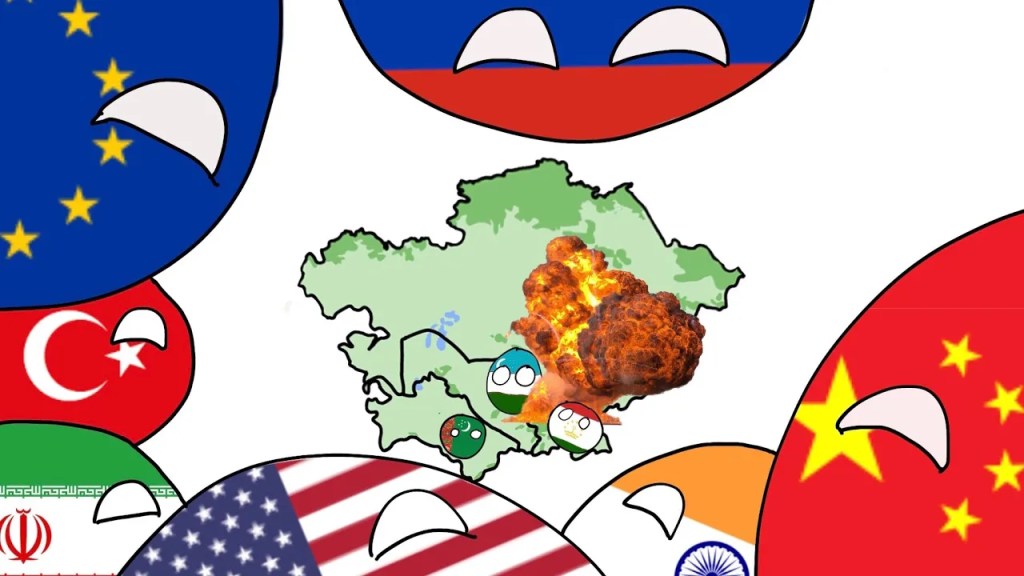
I also made a Countryballs Youtube video about this: https://www.youtube.com/watch?v=mJg52IMScLg
In September 2022, more than a hundred thousand Kyrgyz civilians clogged mountain roads, fleeing from Tajik artillery shells and raids. However, this six-day-long war is merely another symptom of Central Asia’s painful history of Soviet meddling, nationalism, terrorism, and water shortages, which has turned it into a tinder box with potential for war. And with nearby superpowers turning away from the region, war is becoming increasingly likely.
Throughout history, trade routes between East and West joined in Central Asia, including the ancient Silk Road and the modern Chinese Belt and Road initiative, giving it strategic and economic importance for nearby powers. In the modern day, Central Asia has seen additional importance through its plentiful reserves of mineral resources. In particular, it contains more than 30% of the world’s Chromite, a promising material for rechargeable batteries. Control over these resources is becoming more important with the transition toward battery-powered renewable energy. As such, Central Asia is quickly becoming one of the world’s most strategically important regions, and conflict would have profound ramifications on the global economy.
Origins of Conflict: Artificial Nation-States
Modern tensions in Central Asia began with the Soviet policy of “national-territorial delimitation” during the 1920s. To achieve their idea of Socialism in a mostly underdeveloped area, the Soviets attempted to create national identities within the Soviet Union. However, building viable nation-states out of often bilingual and diverse nomadic people, proved difficult. The “republics” born out of this policy were ethnically heterogeneous, with enclave-filled borders that ignored geographic features, especially around the Ferghana valley, which contained most of the region’s population and farmland. However, the borders served mere symbolic and administrative purposes as the nations were still part of the broader Soviet Union.

Borders in the Ferghana Valley
The collapse of Soviet authority in 1991 turned these internal boundaries into international ones. Some of the longest border walls in the world were erected as ethnic violence gripped the new multi-ethnic countries. In 1990 and 2010, the Uzbek minority in southern Kyrgyzstan clashed with government-sponsored Kyrgyz gangs, killing hundreds and displacing half a million people. Troops from Uzbekistan briefly crossed the border to protect its enclaves, showing the potential for internal violence to become international.
Furthermore, the process of demarcating the new borders caused tensions because Soviet maps had changed throughout the 20th century, allowing each country to recognize the one that favored itself. Nationalism stoked by authoritarian or populist governments and neglect for faraway, impoverished frontier regions mean that compromise is rare. Over 1000 kilometers of borders are yet to be marked, including a third of the Tajikistan-Kyrgyzstan border, which has caused numerous border clashes, including the aforementioned 2022 war.
Water Shortages
Tensions are exacerbated by water shortages which threaten millions of farmers and ranchers in the predominantly agricultural Ferghana valley. Between 1961 and 2012, the Tian Shan mountains, whose snowmelt feeds the rivers that irrigate the valley, have lost more than 27% of glacier mass due to climate change. Furthermore, crumbling infrastructure from the Soviet era has caused inefficiencies in water usage, especially because closed borders have made international collaboration difficult. Water shortages have gotten so severe that farmers are “begging God for water.”
Disputes over water rights have often led to riots that escalate into border skirmishes. In 2021, a fistfight between communities on the Kyrgyzstan-Tajikistan border over cameras at a water facility erupted into a firefight that killed 94 civilians and soldiers.
In addition, dams in Kyrgyzstan have restricted the Naryn river, leading to water shortages and tensions with downstream Uzbekistan. When Russia and Kyrgyzstan proposed a hydropower dam on the Naryn river in 2016, Uzbek president Islam Karimov warned that “control over water resources in the republics of Central Asia may lead to a full-scale war.”
Foreign Influences: “The New Great Game”
Central Asian tensions have, however, been put in check by foreign powers, especially Russia, which maintained its cultural, economic, and military influence over Central Asia after the collapse of the Soviet Union. It founded the Collective Treaty Security Organization (CSTO) in 1992 as a defensive alliance, giving it the status of a mediator and a security guarantor. Russia also set up military bases, allowing it to intervene in the 1992 Tajik civil war and the January 2022 Kazakhstan unrest, keeping the peace in what it sees as its own backyard.
However, Russia’s military decline during its 2022 invasion of Ukraine has dampened its influence in Central Asia. It has already withdrawn over 1,500 troops from bases in Tajikistan due to manpower shortages, creating doubts about its ability to intervene in the future. In addition, Russia has refused to help Armenia against Azerbaijani attacks despite treaty obligations, putting the CSTO in jeopardy. As such, Central Asian governments have distanced themselves from Russia by supplying humanitarian equipment to Ukraine or changing alphabets from Cyrillic to Latin.
The United States has also had an influence on Central Asian after its 2001 invasion of Afghanistan. It set up military bases in Uzbekistan and Kyrgyzstan, as the region became a base of operations in the War on Terror. The US also kept a lid on terrorist spillover and trained regional militaries.
After the 2021 Taliban takeover of Afghanistan, however, American attention moved toward Europe and the Indo-Pacific. The incompetence of the Taliban government and American apathy has allowed the Islamic State to launch rocket attacks across the border against Uzbekistan and Tajikistan, destabilizing the region.
With Russian and American influence on the decline, China may step up to dominate this region. Its Belt and Road Initiative, which seeks to create trade corridors between China and Europe, put Central Asia center stage as the middleman between two economic hubs. China has poured over $40 billion into Central Asian infrastructure, and its desire for security on the new trade route manifested as a military base in Tajikistan in 2021.
However, it is doubtful that China will fill the role of a security guarantor. The Chinese military is untested, having not fought a war since 1979, and despite its base in Tajikistan, China still lacks a large military presence comparable to Russia which stationed 7000 troops in Tajikistan alone. Simply put, China does not have the reputation of military power that Russia had.
In addition, Central Asians are becoming increasingly distrustful of China, mainly because of its genocide against ethnically related Turkic Muslims in Xinjiang. The percentage of Uzbeks who see China favorably has declined from over 77% in 2018 to just 44% in 2021, and 68% of Kazakhs are now opposed to Chinese infrastructure development in their country. Without the support of the Central Asian public, China lacks the soft power needed to influence it.
However, the region may not need outside powers to keep the peace. With the death of Uzbek president Islam Karimov in 2016, Uzbekistan has become less nationalistic and antagonistic towards its neighbors. Uzbekistan and Kyrgyzstan have since signed water sharing treaties and border agreements since 2022. Additionally, Kazakhstan and Turkmenistan have settled their border disputes decades ago, and seen relative peace, giving precedent for diplomatic solutions. While numerous issues still remain, particularly the Tajikistan-Kyrgyzstan conflict, Uzbekistan’s new leadership and previous agreements give hope for diplomacy to prevail.
 eric's Writing Portfolio
Leave a comment