
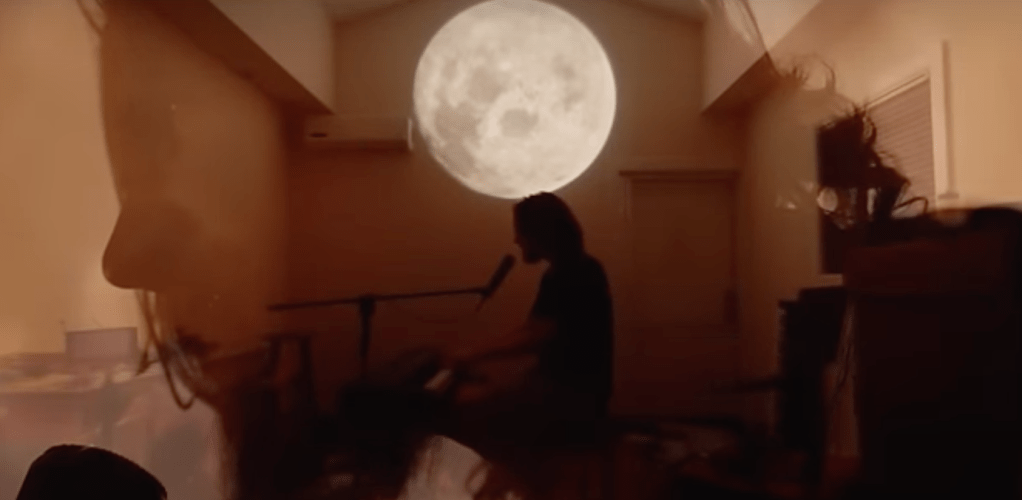
Throughout and before “Goodbye,” Bo Burnham reflects on his journey through the drudgery of quarantine, during which he produced Inside. As a piece of poioumenon, Inside demolishes not just the fourth wall but the barrier between artistry and reality, releasing the difficulties, demotivation, and self-doubt contained within production for audiences to see.
Before “Goodbye” begins, Burnham shows himself creating the film. However, in contrast to the drama and emotion of previous behind-the-scenes clips, he eats cereal while watching a previous scene (1:18:16). The image of an “all-room” is a common theme of quarantine deppression, where the boundaries of life—cooking, eating, sleeping, working, playing—blur in physical space, turning life into dull monotony. Rather than transcending isolation through comedy and art, as suggested by the emotional and energetic nature of the special as well as the fact that he seemingly “got something done,” Burnham faced the same horrors and burn-out while making Inside.
Right before the song starts, he stares at an emotional scene from the previous song, “All Eyes on Me,” and sighs before saying, “I think…I think I’m done” (1:19:12) His sigh and indifferent tone build an anticlimactic silence, where an exhausted Burnham leaves not with a bang of dopamine and reward but a whimper of boredom and apathy in a mess of wires, unclosed drawers, and tripods. Isolation has wrecked his reward system, as finishing has become an arbitrary line in the sand.
As such, Burnham wants to continue working on the project that has become so defining in his life since, as an artist, there is room for improvement. When “Goodbye” begins, Burnham solemnly asks, “Do I really have to finish? Do returns always diminish? Did I say that right?” (1:20:43) He questions the idea that finishing a work brings joy and achievement. The returns on his investment of time and willpower on Inside may “diminish” after all is said and done. The final line, “Did I say that right?” humorously shows the self-critical and perpetually perfectionist experience of art without deadlines, separated from the world or outside. When there is always work to be done, it is painful to let go, finish, and move on from a project.
Burnham also reflects on the role of an audience in artistry when he says, “Does anybody want to joke when no one’s laughing in the background?” (1:20:50) He thinks about how the joy of comedy is in making others laugh. Before he begins “Goodbye,” Burnham squints at the camera as if looking for an audience, but of course, an audience aloof in both space and time is not the same. During quarantine, without an audience, it must have been hard for Burnham to focus and have the motivation to finish such a project.
However, as he says “laughing in the background,” the close-up shot of his face is superimposed upon by a long shot of him playing the piano as if performing to an audience (1:20:53). The close-up image shows Burnham’s face, emotions, and wrinkles, however, fading suggests that to focus on the audience and their laughter is to remove what makes an artwork human. The next lyric “So this is how it ends” suggests that the end of this project is to publish it and with that, take away the emotions of production. In addition, the first time the superimposition happens it fades back to a close-up shot, however, the second time, he says to the audience, “I wanna hear you tell a joke when no one’s laughing in the background,” and the scene permanently shifts to a far shot (1:21:54). When he asks the audience to imagine themselves in his shoes, Burnham turns completely into a performer for them. In the end, Burnham says that all he ever wanted was “a little bit of everything all of the time,” referencing the previous song, “Welcome to the Internet,” showing that Burnham has always wanted to be known (1:22:53). His audience’s apathy is a tragedy and their boredom a crime, reflecting that as publication nears, his attitude toward his work begins to shift from self-enjoyment as an artist toward satisfying his audience.
As Burnham exits the Inside where he serves only himself and uses only his thoughts, depicted in the film as Burnham literally leaving his house, he exits not to sunlight but spotlights (1:23:14). He bangs on the locked door with regret, wanting to escape the audience laughing in the background at his suffering. He has now become an object of their fascination and play. One must wonder whether Burnham was right in wanting to stay inside and never finish.
 eric's Writing Portfolio
Leave a comment