
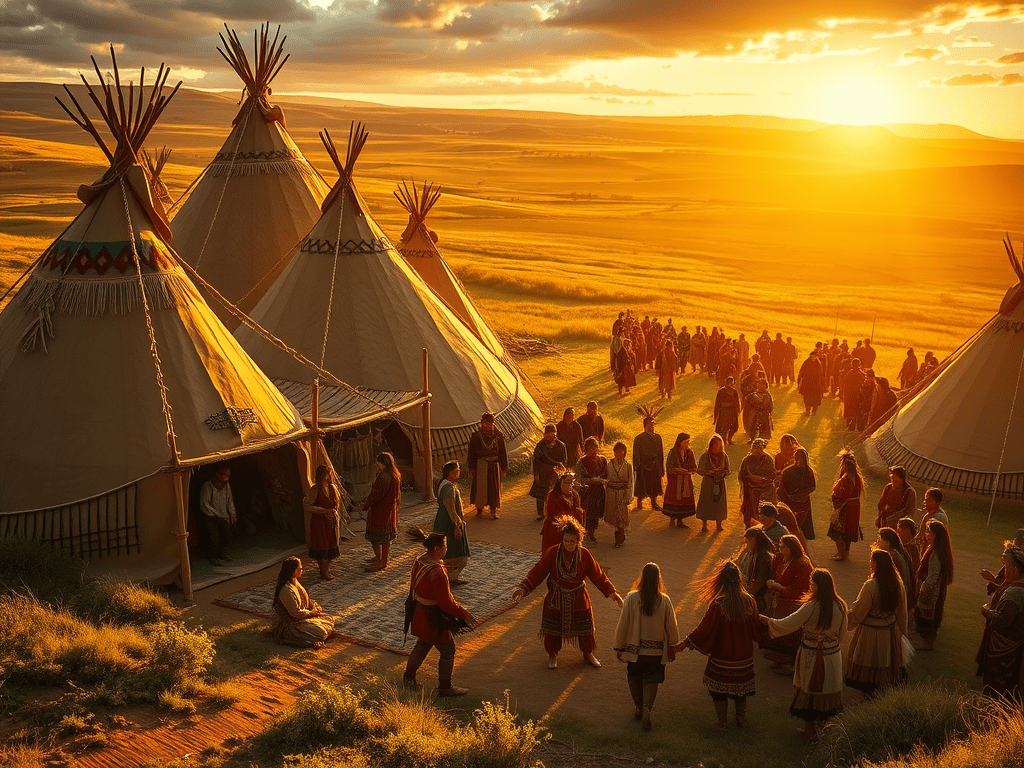
For centuries, the Mandan nation was the center of trade and agriculture on the Northern Great Plains, filled with vibrant culture and religion. Traders from as north as the Hudson Bay, south as modern-day Mexico, east as the Great Lakes, and west as Oregon came to the Mandans’ impressive market towns. After the arrival of Europeans, the Mandan benefited greatly as a center for the fur trade, which came from both the United States to the east and from the British Hudson Bay Company to the North (Fenn, 121). They hunted plentiful herds of buffalo on the Great Plains and farmed corn, allowing it to trade with non-farming tribes. As a settled civilization, each of the Mandans’ nine sprawling towns contained around a hundred meticulously built earth lodges and about a thousand residents who lived densely with strong fortifications shielding them against outside incursions (Britannica). Before European contact, the Mandan population reached a peak as high as 20,000, though that would drop to around 4,000 by the 19th century (Daily Beast). Residents did not own land but instead worked for collective benefit, storing excess corn and buffalo hides in underground communal storage (North Dakota Studies). Inside each town, there was a building known as the Okipa lodge, built into the Earth, where the Okipa Ceremony would take place. For four days of the year, the Mandan reenacted the history of the Earth in a great show of their resilience and unity. They would fast, celebrate, and perform certain kinds of self-sacrifice, culminating in a great dance where the entire town would come together in a massive circle (Britannica). Visitors from places as far away as France marveled at the great joy and celebration that unified the Mandan during the Okipa (Fenn, 104). However, during the era of American Westward expansion, invasive species and diseases decimated this magnificent civilization on the Great Plains, and despite having a long, successful partnership with the United States, Uncle Sam took advantage of the Mandans’ weakness to steal their land and culture.
The 1803 Louisiana Purchase and subsequent 1804 Lewis and Clark expedition birthed a bustling trade relationship between the Mandan and the United States. However, the interconnectedness that brought the Mandan exorbitant wealth also brought biological terrors that the Mandan had never seen before. In 1825, at least two Brown rats hopped off an American steamboat resupplying at the Mandan markets (Fenn, 412). Within a year, the Mandans’ communal corn stocks disappeared because the Brown rat reproduced quickly and dug long tunnels into the ground, allowing them to reach subterranean corn stores (Fenn, 413). While unintentional, American westward expansion introduced an invasive species that destroyed the Mandans’ food security. To help alleviate the food crisis and protect hunting grounds from the Sioux who wanted to take advantage of Mandan weakness, the Mandan cooperated with the neighboring Hidatsa and Arikara nations by sharing buffalo meat and hunting together as that became the primary source of sustenance. However, soon after the Mandan recovered from the rat infestation, western expansion brought something much worse: smallpox. Smallpox had affected the Mandan before, but the epidemic of 1837 was especially deadly. Parts of the American government that supported western expansion had deliberately hindered Native American vaccination even though many traders had requested it (North Dakota Studies). In addition, because the Mandan lay within American territory, the Hudson Bay Company, which had conducted a highly effective vaccination campaign at the same time in British North America, could not reach them (Encyclopedia of the Great Plains). Consequently, when the steamboat, St. Peters, brought smallpox to the Mandans’ densely populated market towns in 1837, almost ninety percent of the Mandan population perished (Fenn, 364). Out of the 2000 Mandans that lived on Knife River, just 138 survived the epidemic (North Dakota Studies). The Mandan had practically disappeared as a significant power due to factions within the American government that wanted to exterminate the Mandan for western expansion. Seeing their villages and livelihoods destroyed, hundreds of Mandans also committed suicide (North Dakota Studies). Under these circumstances, the Mandan survivors unified with the Hidatsa and Arikara to form a new village, Like-A-Fishhook, in 1845, where they would work together to survive and defend themselves (Fenn, 375). Thus, western expansion and the policies the American government adopted to pursue it decimated the Mandan, forcing them to unite with neighboring tribes to survive. However, despite the United States’ complacency in the Mandan’s devastation, the two countries remained partners.
The United States and the Mandan were close allies commercially and militarily throughout the middle of the 19th Century. The United States and the Mandan had been allies since the Lewis and Clark expedition, where the Mandan had been gracious hosts to Lewis and Clark during the unusually cold winter of 1804-1805, providing them with food, shelter, and supplies. The Mandan chief Sheheke even visited the White House (History.com). Since then, the Mandan had pursued friendly relations with America, which created trade but also guaranteed American protection in the Intercourse Treaty of 1825 (Fenn, 312). In the 1850s, the Sioux repeatedly attacked Mandan villages and stole their hunting grounds and corn, prompting the Mandan to ask for American military assistance (ND State Historical Society). America and the Mandan became allies, with America providing arms to Like-A-Fishhook village and setting up forts nearby to protect them. For example, during a Sioux raid on Fort Berthold in 1862, Mandan warriors emerged from their village and saved the American troops stationed there from annihilation (Britannica). America’s partnership with the Mandan is most aptly demonstrated by the fact that orders were given to General Custer in 1874 during the Black Hills Expedition to defend the Mandan the same as white settlers (Fenn, 410). During this time of peace and cooperation with America, the Mandan began to recover as Like-a-Fishhook village became a significant trading hub in its own right, with a combined population of around 2,000 (Britannica). They began practicing the Okipa again as it became a celebration that united the tribe and commemorated the past. In the Fort Laramie Treaty of 1851, the US government agreed to provide the Mandan, Hidatsa, and Arikara with 12 million acres of land, which guaranteed their sovereignty and independence as a group (Britannica). Thus, during western expansion, the Mandan were allied to the United States, which helped it defend itself and recover from the rat infestation and smallpox epidemic. However, this alliance with the United States would not last, as after the Sioux were defeated, the United States betrayed the Mandan
In the late 19th Century, the United States began to encroach upon the Mandans’ land and culture. The construction of the Northern Pacific transcontinental railroad, which passed through Mandan lands, put pressure on the Federal government to reduce the size of the Mandan reservation (North Dakota Studies). Consequently, an executive order in 1880 took all Mandan land within 40 km of the Northern Pacific Railroad, which comprised almost ninety percent of the Mandan, Hidatsa, and Arikara’s lands. To weaken Great Plains nations, the railroad companies and army also began sponsoring hunting teams, which decimated buffalo populations, destroying the Mandan way of life and food security (Daily Beast). These policies culminated in the Dawes Act of 1887, which forced the Mandan to leave behind their communal values to live on land allotted by the government, with the rest of their land being sold to white settlers. The Dawes Act aimed to assimilate Native Americans by forcing them to become farmers who participated in a capitalist society (Britannica). Because of this, by the 1890s, Like-A-Fishhook village had become abandoned as the Mandan had been forced off the last place that they could be together as a nation (Fenn, 489). The Dawes Act also opened the door for white settlers to enter Mandan lands as white settlers gained the lands that were not allotted to any Mandan (Britannica). White ranchers began moving into originally Mandan lands as it was prime agricultural land and the railroad made it accessible (Graybill). The Mandan and their allies were militarily weak and could not resist through force, so they stuck to the ritual that had kept the tribe together for years: the Okipa. It gained a new meaning not just as a religious celebration but as a way to get through hard times and maintain their culture in the face of imperialism (Fenn, 501). Seeing the Okipa as a backward and dangerous celebration, the army officers in charge at Fort Berthold, the same fort that the Mandan had defended in 1862, suppressed it in the 1880s by forcibly preventing people from participating (Fenn, 513). The last Okipa was performed in 1890. Thus, when the United States found the Mandan to be in the way of its perception of progress, it destroyed the Mandans’ way of life and culture.
Westward expansion has left deep scars on the Mandan and their affiliated tribes that have fundamentally changed how they live. A nation of thousands had been reduced to a couple hundred, and its land and resources were taken, preventing them from expressing their culture and way of life. These conditions have forced the Mandan to partially assimilate into American society. In 1934, the Indian Reorganization Act allowed the Mandan, Arikara, and Hidatsa to run their own government on the reservation, which gave them hope for a return to a communal, self-sufficient lifestyle (Brittanica). However, with the best agricultural land and hunting grounds unavailable, they simply could not grow their own food or hunt for themselves like they used to (Fenn, 513). Additional dams and white settlement in the surrounding areas, especially the Garrison dam on the Missouri river, exacerbated the problem by flooding much of the Mandans’ best land and numerous villages, forcing many to relocate (Daily Kos). Due to the Mandans’ low population caused by westward expansion, they simply lacked the voting power to prevent any of this. Instead of hunting and growing their own food, Mandans now rely on surplus food provided by the government, which is often heavily processed, leading to numerous health problems on the reservation. A sedentary, hopeless lifestyle has also pushed many Mandan into alcoholism (Daily Kos). Westward expansion had taken much of the soul of the Mandan nation. In addition, because of the American suppression of this ceremony, the Okipa would never be practiced again, destroying this essential part of Mandan culture. In light of these facts, it is clear that westward expansion had killed much of the Mandan people through disease and pests, but also that during westward expansion, the United States betrayed the Mandan, stealing their land and suppressing their culture.
Works Cited
Britannica, The Editors of Encyclopaedia. “Mandan” Encyclopedia Britannica, 3 Jun. 2019, Accessed 8
November 2022.
“Encyclopedia of the Great Plains.” Encyclopedia of the Great Plains | OKIPA, Accessed 2 Nov 2022. Fenn, Elizabeth A. Encounters at the Heart of the World: A History of the Mandan People. Hill & Wang
Pub., 2015. Print.
Graybill, Andrew. “The Tribe at the Center of America: The Story of the Mandan.” The Daily Beast, The
Daily Beast Company, 12 July 2017, Accessed 3 Nov 2022.
History.com Editors. “Lewis and Clark Expedition.” History.com, A&E Television Networks, 9 Nov.
2009, Accessed 3 Nov 2022.
“Indians 101: The Mandan Okipa Ceremony.” Dailykos.com, 29 October 2020. Web. Accessed 3 Nov
2022.
“Section 3: Smallpox Epidemic of 1837.” NDStudies.gov, North Dakota Studies, Web. Accessed 4 Nov
2022.
“How the Garrison Dam on the Missouri River Ruined a Way of Life for the Mandan, Hidatsa, and
Arikara.” Dailykos.com, 26 December 2018. Web. Accessed 7 Nov 2022.
“Dawes General Allotment Act.” Britannica.com, Encyclopædia Britannica, Inc., Accessed 4
Nov 2022.
“People Encountered-Like-A-Fishhook Village.” History.nd.gov, State Historical Society of North
Dakota. Accessed 5 Nov 2022.
 eric's Writing Portfolio
Leave a comment